
The first day of my first-ever proper hike coincided with the summer solstice last month. For a week, I got to explore southern Italy’s Campania region, most particularly the Amalfi coast, soaking up the jagged coastline, the vastness of the blue sea blending into the sky…
We visited Mount Vesuvius whose eruption in 79 CE buried Pompeii, together with other Roman towns and villas, in volcanic ash and pumice. I learned that about a quarter of ancient Pompeii is yet to be excavated. That the Amalfi coast inspired many artists, including D. H. Lawrence and his Lady Chatterley’s Lover and Patricia Higsmith, author of The Talented Mr. Ripley, to name but two. That unripe walnuts, with their fuzzy, greenish husks, resemble kiwis. I saw a caper bush for the first time in my life and had no idea the plant on which capers grow was so beautiful.
Not a bad way to start summer! The breathtakingly beautiful views and these learnings aren’t the main things that made the trip meaningful though.
Despite a pretty bad ankle sprain about a month before, I walked on rocky tracks, narrow fenceless trails alongside sharp cliffs, forest paths, went up and down big, ancient steps, and alternated steep ascents and descents, my feet adapting to the varying terrain. I never needed physiotherapy until just prior to this. It reminded me how important it is to listen to your body, every small part of it, to find a balance between overprotecting yourself and overextending yourself, between rest and self-imposed challenges beyond your capacity.
This calls to mind the Path of the Gods which I almost skipped because of my fear of heights. I’m glad I didn’t because it ended up being my favorite adventure of the trip. At the same time, I’m glad I went at my own pace. It was a mindfulness exercise: I immersed myself in the present moment, thinking only about my hand on the walking pole, my foot, this movement, then the very next one, focusing on the back of the person in front and, when it felt safe, admiring the peaceful panorama.
And I wasn’t alone. I walked with a group of strangers who, of course, by the end of the stay, were no longer strangers. Our guide and my fellow hikers were kind, funny, supportive… I feel that in almost any group, someone will naturally take the role of nurturer, someone else will be the joker providing comic relief at the most opportune time, and so forth. Yet the healthiest environments are perhaps those where everyone feels free to step out of a role, if need be. There was a certain harmony, a go-with-the-flow quality to this group, a collective emotional intelligence of sorts: just like we never stopped anywhere for too long, people seemed to know when to give pep talks and when to give space, when to keep the conversations light-hearted and when it felt right to have deeper talks.
I loved sharing this whole experience with other people. Still, as an introvert, I was thankful for the chosen solitude a couple hours a day. My room in a lovely family-run hotel in the village of Bomerano felt like a compact, temporary home. In in-between places like hotels, airports, or train stations, for instance, everyone is in transit and out of place, and there’s solace in knowing you’re not expected to belong or to know exactly what you’re doing and where you’re going.* We still try and put on a front though, and only away from others’ eyes, in hiding places within public spaces, do we take off our masks.
As a little girl, in the back of the car, I’d happily wave hello to the driver behind us. When they’d wave back and smile, I’d write the number plate down to recognize the car if our paths were to cross again, because it meant I’d made a new friend. It was a short-lived phase, I never looked at my notes, and soon restraint replaced spontaneity. Are all stories about growing up variants of this one, stories that involve becoming more fearful of the world and of people, despite loving them?
Animals gave joy and emotional support, too. I saw butterflies of all colors, goats among the trees, dogs, cows, horses, and so many cats. It was as though they were cheering us on.
I photographed them with the same sense of wonder I photographed iconic sights because the latter will likely remain for a long time still, but the spontaneous butterfly that appears in the shot you had your eye on, and lingers for a little while, feels like a momentary miracle. Had you arrived seconds later, it would have been gone, and you would have seen a completely different scene. It’s the kind of pictures I prefer taking and looking at.
The unplanned, ordinary things tend to become the memories that feel most impactful: the sudden storm we waited out towards the very end of our Pompeii tour, the welcome breeze and salty drops of water on my face on the boat from Capri, the absence of the beings we miss that has a way of making itself felt through random things – which feels very real but is uncapturable…
And, again, it’s the little things that were the biggest sources of gratitude, like being invited to come along on improvised excursions during our free time, drinking water during our breaks, taking a shower before putting on a clean shirt after a long day spent drenched in sweat… One of my favorite sayings in French is “après l’effort, le réconfort” (“after effort comes comfort”). Not that I think rest is to be earned but, perhaps because of the immediacy and starkness of the contrast, rewards feel better indeed after strenuous efforts.
The Amalfi coast is known for its lemons, so another saying I thought about during this trip is “when life gives you lemon, make lemonade.” Well, it turns out you can also make lemon delights, lemon slushes, limoncellos, gelatos… Of course, I’m not really talking about lemons. We too can transform life’s difficult situations and ourselves into a thousand delicious ways. The good doesn’t last forever, but neither does the bad: as Douglas Coupland once said, “nothing very, very good and nothing very, very bad ever lasts for very, very long.” Having off days, some days, is part of being human. I had off days there, too, but venturing outside every day meant no day was entirely bad. Whatever our wound, whatever thing is haunting us, there’s something to be said for walking it out, for setting it in motion, for letting things and people – including yourself – gently shape-shift.
*this thought was inspired in part by The School of Life’s post “The Strange Comfort of Lonely Places” on June 19, 2026
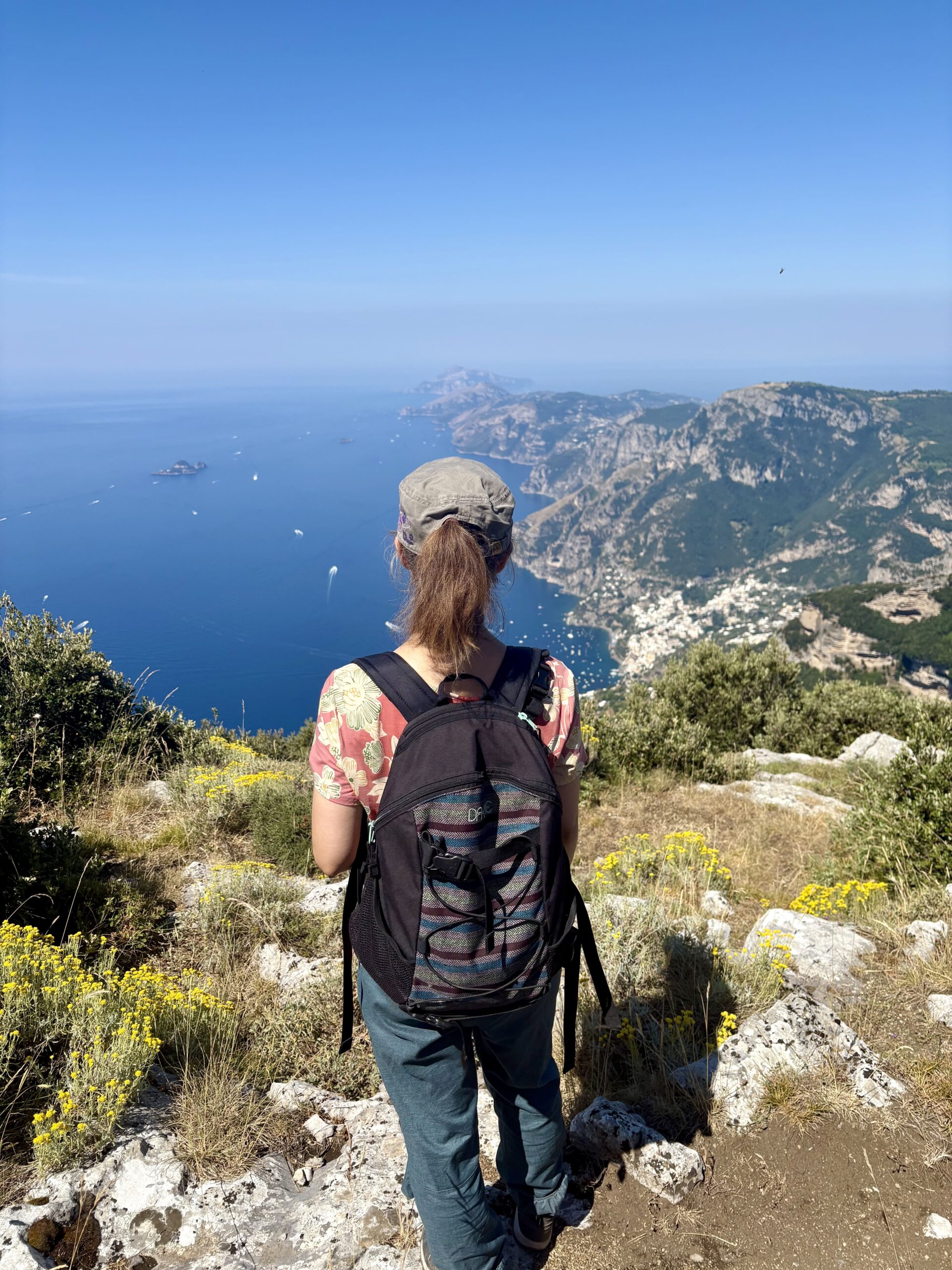
Monte Tre Calli, last hike © 2026 Surya Ohara

I really enjoyed reading about the hiking expedition you made along the Amalfi coast. I’ve heard it’s quite a beautiful region of Italy, and your descriptions make it sound like a fascinating place to visit. But beyond the breathtaking sights, I appreciate your observation that it’s actually the small moments you treasure most from your trip, which you revisit from the photos you took, the memories you made, and the feelings of joy and gratitude that stay with you. I’ve also noticed that I cherish the small moments most from my own travel experiences. I wonder if it’s because we all see the same sights when we visit iconic places, but it’s the fleeting sensations, impressions, and surprises from moment to moment that make the experience uniquely personal for each of us. When we interact with such a place, we get to take our memories of it home, and it becomes a part of us.