On May 17, 2001, my father breathed his last breath. 9 days later, I turned 10. I look again at this photo of the birthday party two days after my actual birthday: here I am in a pale green Winnie-the-Pooh outfit, a frog scrunchie holding my hair in a loose ponytail, a sad yet genuine smile on my face moments before the sparkler candle on my ice-cream birthday cake goes out. Still very much a little girl whose dearest wish, apart from a lop-eared rabbit, was for her dad to come back.
Every May 26, excitement is tinged with a certain guilt about celebrating my birth. As the anniversary of my father’s death is approaching, so too is my birthday, and I’m reminded that I’m still here and he’s not. Traditionally, in our family, when setting the table on Christmas Eve, we leave a chair empty to welcome any mystery guest, any “lost traveler”, who might turn up. Even if we don’t do that for birthdays or other events, I’d like to think there’s always an imaginary extra seat among us for my father, that he is the lost traveler every time.
I’ve spent many more years without him than with him. And yet, he’s shaped my life in immeasurable ways, and I don’t think you ever get over losing a parent as a young age. My dad would frequently travel to Laos, his home country, for work, but I never resented him for his absences. Our reunions would feel like big celebrations: he’d come back with a suitcase full of presents from aunts and uncles, and just seeing him again was enough for joy to overwhelm me. For a while I filled the gaps in our story with an idealized version of him. Well after this death, I kept getting to know him in a sense, slowly becoming aware of the less heroic, more human parts of him, and accepting the missing answers.
Today, 25 extra candles later, I’m beginning the first chapter of the second half of my 30s. I can’t quite believe I’m now closer to my forties than I am to my twenties. Where did the time go?
As a child, I was told premature gray hair was a sign of intelligence, so I’d feel triumphant whenever the odd gray hair would pop up, and I’d simply pluck it. I’ve since stopped counting, and no longer feel triumphant, or smarter. I don’t feel wiser either, which is why this isn’t a “35 things I’ve learned from my 35 years on Earth” kind of post, though I love list articles.
Some things haven’t changed though: ice cream remains one of my favorite indulgences. Also, I still feel shy on my birthday, even around people I’ve known my whole life. A relatable passage in the story “Cold Pastoral”, from Marina Keegan’s collection The Opposite of Loneliness, comes to mind: “I remember finding it extremely hard to open presents as a child because the requisite theatricality was too exhausting.” It’s comforting to know I’m not alone, that even people used to entering a room with all eyes on them can echo that sentiment: in a 1986 interview with Joe Smith, Joni Mitchell says “I still don’t really like the attention of a birthday party. I prefer Christmas, you know, which is everybody’s holiday.”
The age of 35 is widely regarded as a turning point for women, with our fertility decline accelerating. Beside hormonal, metabolic, and other kinds of changes, many of us are faced with big life decisions to consider: Should I freeze my eggs? Should I create a pension savings account in addition to my regular savings account? Should I buy a house I can’t picture myself in in the long run or keep renting this placeholder apartment until I find my dream place?
If you’re anything like me, you’re more likely to google, say, “where do bees go in winter” or “where do ducks go when lakes freeze over”, out of curiosity about random trivia, than you are to search for ways to increase your wealth or influence. When building a life, how do we strike a happy balance between practicality and whimsy? How much space should we allow our daydreams to take up?
Though we’re not at all old-old yet, we’re no longer young adults. Perhaps it’s this realization that makes these decisions appear more high-stakes than they already are: if we mess up, we might not get away with it the way we used to. Or perhaps it’s the determination not to add to the pain, the trauma even, brought by decisions we now regret – like accepting that job or that relationship our gut warning us against, what have you; the determination to make the uncertain future a little less scary.
The piles of blank notebooks and unread books, the partial pieces of writing, the unfinished projects, give yet other anxiety-inducing questions to ponder: Will I ever get round to doing what I want to do with my life? Will I ever become who I’ve been aspiring to become? At the same time, there’s this sense of possibility, of hope, I try not to lose. It might, in fact, be the maybes that lead us to string days together and make a life. The moment-to-moment decisions we make can be as important as the big decisions.
Some of us seem to go through many destruction-reconstruction cycles and need to hit rock bottom to go back up, adopting an all-or-nothing approach to life. Others seemingly need to only lightly touch despair with the tips of their fingers rather than marinate in it until they’re nauseous. Whatever our patterns so far, I believe we can change, that our identity isn’t fixed. It makes sense to say that at 35 we know ourselves better than we did at 25 for having spent more years with ourselves. However, there’s still so much we don’t know – about ourselves and the world – which is a good thing, I reckon, again clinging to possibilities.
I wish I were less of a people pleaser by now, but I don’t think we can ever entirely stop caring about what other people might think of us – nor should we want to. Perhaps as you get older you simply have less time to waste. Or you’re more selective about the things you waste your time on.
This brings me to self-care, the idea and practice of balancing outward focus with a self-compassionate, inward-looking perspective. I’ve learned that caring for ourselves isn’t only about pampering ourselves or even following through with the things we promised ourselves we’d do. A big part of it is about the quiet, everyday acts of service to ourselves.
We help ourselves out, when we wipe down the kitchen counter after doing the dishes, clear the food debris clogging the sink and the crumbs under the table mats; when we remove limescale from the kettle; when before going to bed we leave on the dish rack the necessary cutlery and tableware for tomorrow morning instead of putting them back in the cupboard; when we make our bed, fold our pajamas; when we put calming music on, light a candle that feels like a big hug, or make sure our basket’s full of fresh fruit; when we wrap our hands around a hot mug. What if these were in fact small ways for us to be mindful of our own time and energy, to tend to our home so we feel safe in it? Perhaps creating peace around us is a means to compensate for the lack of order inside us and the myriad things escaping our control, but a certain contentment can be found there, too.
All sorts of obligations are tied to the thick of adult life, but I find there’s lots of freedom in some respects, especially if you live alone. Doing grocery shopping is one of my favorite things about being a grownup: you decide what to put in your cart. I also enjoy the freedom of getting to make yourself a tried-and-tested homely meal or to try a fancy new recipe, if you feel like it; of sometimes dining on what you’d have for breakfast, or eating right out of the pan.
Speaking of which, it’s time for lunch here and, why not, some leftover birthday cake. I’ll see you next month but, before you go, please feel free to tell me about you:
In what ways have you changed since childhood, and how are you still the same? Who’s the “lost traveler” you miss terribly and wish would fill the empty chair next to you? If you could go back, would you do some things differently, or wouldn’t you change a thing because of the lessons that came with the decisions you made then? Do you find maybes scary or empowering? How do you look after yourself? What are some aspects of adulthood you consider forms of freedom?
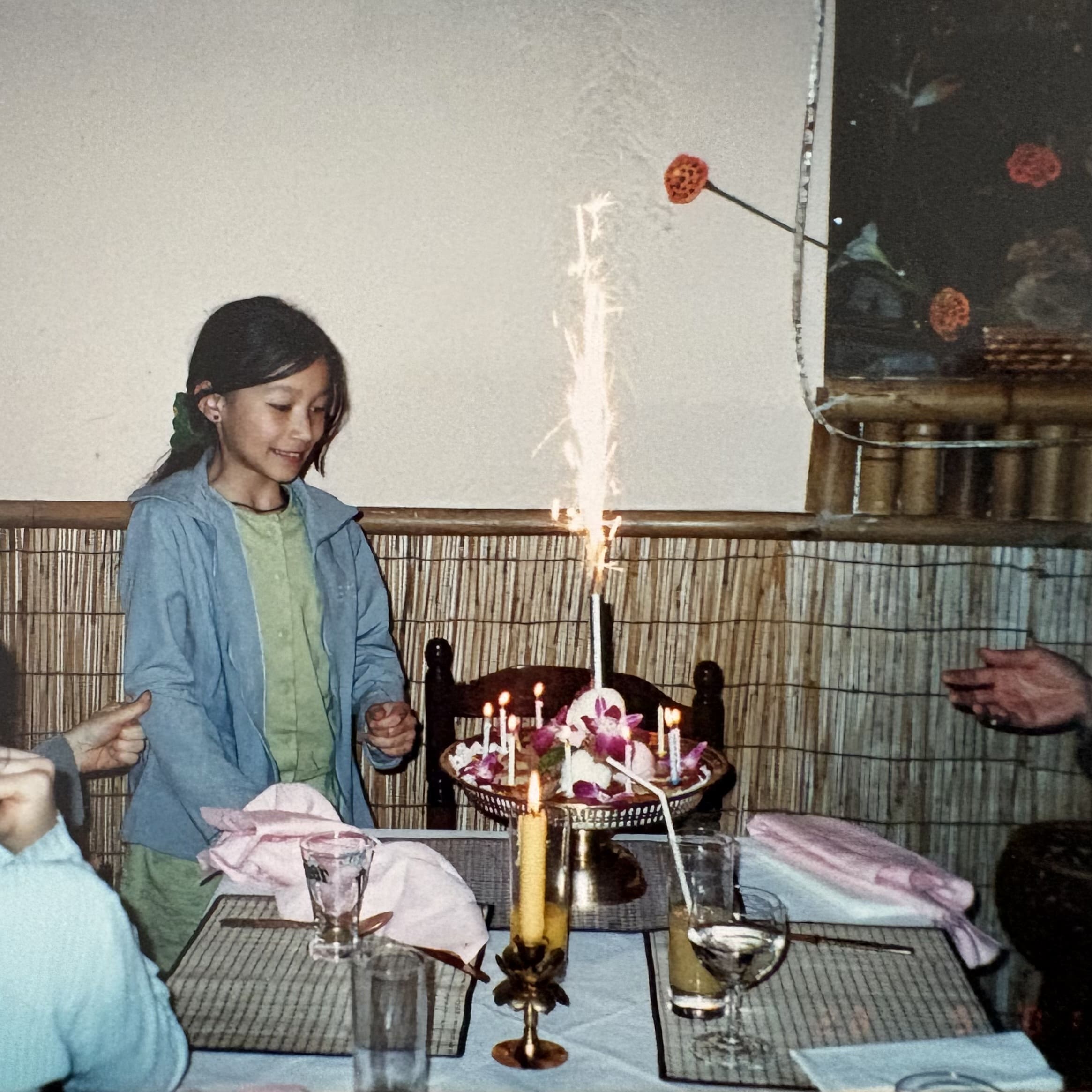
First birthday without my father, 25 years ago © 2026 Surya Ohara